

2·
7 months agoYou’ve lost another submarine?
You’ve lost another submarine?
No. A full breakdown here https://youtu.be/1dhvry6E0jA

The power aspect is a lot bigger of a factor than I would have thought. I had an old computer I was going to use as a server for Foundry that I could keep up all the time, but when I measured its wattage and did the math, it would cost me $20 a month to keep on. A pi costs like $2 to keep running, so it paid for itself pretty quick
At least plugging them all into Google translate, the pronunciations are actually all pretty similar, with Swedish being the most dissimilar
I think they’re making a joke that one of the definitions of “revolution” is making a complete circle. In the cartoon, “reform” is making a ton of revolutions.
I’ve used them both a good bit for D&D/TTRPG campaigns. The image generation has been great for making NPC portraits and custom magic item images. LLM’s have been pretty handy for practicing my DM-ing and improv, by asking it to act like a player and reacting to what it decides to do. And sometimes in the reverse by asking it to pitch interesting ideas for characters/dungeons/quest lines. I rarely took those in their entirety, but would often have bits and pieces I’d use.
I probably do this a good bit without really thinking about it. I don’t really care about walking in mud/grass and I like to give people their space. The fact that they continued to walk on the grass after they passed makes me think it wasn’t a big deal for them either.

it isn’t possible to synthesize neutronium at that amount or handle that much safely.
To be clear, the neutronium you’re talking about here is the one that is theorized to exist at the core of neutron stars? Could you elaborate on how much has been synthesized and could be handled safely?
Relevant xkcd’s

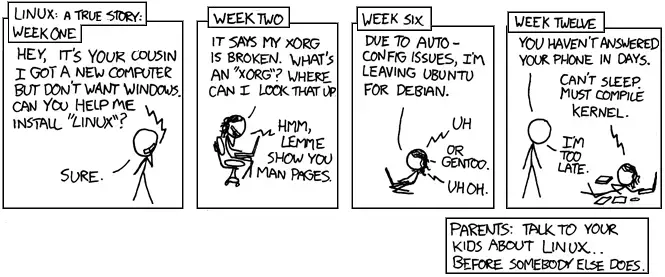
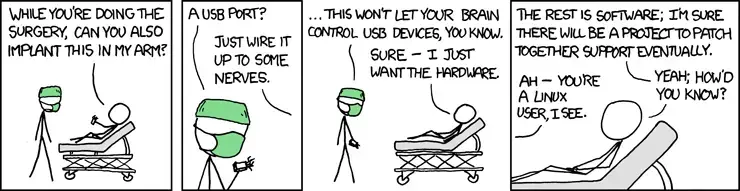
I would throw out that Windows executables work surprisingly well on Linux these days via “wine.” I use EndeavorOS and it’s pretty much no work on my part, I double-click a .exe and it starts it up via wine. I think the only thing that’s been spotty for me is Meshmixer crashes sometimes, but it’s also abandonware so I’m not sure it actually runs better on Windows.
I’m super curious about that hole in Texas for “dude.”
Oh, I don’t heat it at all, I just eat it room temperature
To me, the potential point of confusion is referring to “sent by Ctrl+D” and things “received by the end process” as synonymous, ignoring the tty driver in between. When you Ctrl+d, you send a magic byte value to the tty master (which I would refer to as a EOF character, but I understand the argument against the terminology). On the other side of it the process doesn’t receive this value, but instead has its read call returned even if the buffer is 0.
A simple example hopefully highlighting the difference
Window1:
nc -nvlp 5555 #"far nc"

Window2:
nc -nv 127.0.0.1 5555 #"local NC"
Hi there[Enter]
Hi [Ctrl+D]There[Ctrl+D][Enter]

Window3:
strace -p [pid of local nc]

Window2:
[Right arrow][Right arrow][Ctrl+D]
[Ctrl+D]Uh oh[Enter]
What we see is pretty much as described. From the first line, we see “Hi there\n” on the other side. For the second line, we first see "Hi " appear, then “There” then “\n”.
From the third line, in the strace we can see the sequences representing the right-arrow key, and we can see the tty driver on the far side takes those sequences and interprets them to render the cursor two characters to the right.
The fourth line is where it gets more interesting. We send the tty driver the EOF byte, and the tty driver interprets this and gives the current active tty client a 0-byte return to read() and assumes we have no more data to send. But unlike bash, nc doesn’t care about a 0-byte read and is still looking for more data (as we can see in the strace). But if we continue to type and send more data (the “Uh oh”), we can see in the strace that the tty never sends this to the nc. So, to some definition, we’re still sending data to the local nc, but the tty driver isn’t actually relaying it
Think about how quickly the entire WWWIII (Wizarding-World War III) would have ended if all of the good guys had simply armed up with good ol’ American hot lead. Basilisk? Let’s see how tough it is when you shoot it with a .470 Nitro Express. Worried about its Medusa-gaze? Wear night vision goggles. The image is light-amplified and re-transmitted to your eyes. You aren’t looking at it—you’re looking at a picture of it. Imagine how epic the first movie would be if Harry had put a breeching charge on the bathroom wall, flash-banged the hole, and then went in wearing NVGs and a Kevlar-weave stab-vest, carrying a SPAS-12. And have you noticed that only Europe seems to a problem with Deatheaters? Maybe it’s because Americans have spent the last 200 years shooting deer, playing GTA: Vice City, and keeping an eye out for black helicopters over their compounds. Meanwhile, Brits have been cutting their steaks with spoons.
Remember: gun-control means that Voldemort wins. God made wizards and God made muggles, but Samuel Colt made them equal. Now I know what you’re going to say: “But a wizard could just disarm someone with a gun!” Yeah, well they can also disarm someone with a wand (as they do many times throughout the books/movies). But which is faster: saying a spell or pulling a trigger?
Avada Kedavra, meet Avtomat Kalashnikova. Imagine Harry out in the woods, wearing his invisibility cloak, carrying a .50bmg Barrett, turning Deatheaters into pink mist, scratching a lightning bolt into his rifle stock for each kill. I don’t think Madam Pomfrey has any spells that can scrape your brains off of the trees and put you back together after something like that. Voldemort’s wand may be 13.5 inches with a Phoenix-feather core, but Harry’s would be 0.50 inches with a tungsten core. Let’s see Voldy wave his at 3,000 feet per second. Better hope you have some Essence of Dittany for that sucking chest wound. I can see it now…Voldemort roaring with evil laughter and boasting to Harry that he can’t be killed, since he is protected by seven Horcruxes, only to have Harry give a crooked grin, flick his cigarette butt away, and deliver what would easily be the best one-liner in the entire series: “Well then I guess it’s a good thing my 1911 holds 7+1.” And that is why Harry Potter should have carried a 1911.
Ah gotcha, I was wondering where I might’ve lost the thread. I would agree with everything you said there. But, putting a pin in that and going back to your original post, what are the lore changes that you dislike? I understand what you said regarding inter-species complications, but feel like I might have lost what you were saying after that.
Honestly, I’m a bit more confused now. I definitely agree that humans have a tendency to dehumanize others, but I wouldn’t consider this a good or healthy thing that we should just accept. So having a ruleset that says, canonically, “this group of sentient creatures is inherently evil” and not “this group of sentient creatures is believed to be evil by this other group” you are encouraging the players to take an unnuanced view of the world.
However, as a gamemaster you have to allow your players to make two choices:
- Are the monsters we are fighting people or not?
Isn’t this what the lore changes encourage, by not making a factual statement about the groups, so the players should ask themselves this question on a case-by-case basis and not simply based on what type of creature they are? And I’m not sure how the changes would prevent the narrative approach you describe. Saying that goblins and orcs live in human-like societies doesn’t prevent you from telling a story that’s analogous to what has happened between human societies.
Maybe we’re working off of different data points, what WotC material are specifically referring to for the changes?
A game about combat needs a world full of things for the players to mow down but also not feel bad about killing, and sometimes you need a bunch of Violent Dungeon Fodder that can think and plan and make tactical decisions and potentially be negotiated with.
I’m a bit confused by this. Why not have them be any other species, or combination of them? If they’re capable of being negotiated with shouldn’t the players feel as bad about killing them as anyone else? I feel like “self-defense” can do a lot of heavy lifting in dungeon crawls, I’ve never really noticed my players feeling bad about killing bandit dwarves or whatnot.
I’m not sure I understand how you’d shred your fingers on them. I put my nail under the tab and lift until my finger can get under it
Sorry, I was looking more specifically at that DNAT rule
8 480 DNAT 6 -- * * 0.0.0.0/0 0.0.0.0/0 tcp dpt:2222 to:192.168.101.4:22
That rule exists in the host 192.168.86.73, correct? And from the guest, 192.168.101.4 you are attempting to ssh into 192.168.86.73:2222?
It might not be your issue (or only issue), but that DNAT rule says that if a connection comes in on port 2222, instead send it to 192.168.101.4:22. So 192.168.101.4->192.168.86.73:2222->192.168.101.4:22. I would have thought you’d want it to be a DNAT to 192.168.86.73, functionally doing port bending, so it goes 192.168.101.4->192.168.86.73:2222->192.168.86.73:22.
That doesn’t explain the connection refused, though, based on what you’ve said; there’s some fringe possibilities, but I wouldn’t expect for your setup if you hadn’t said (like your ~/.ssh/ssh_config defining an alternate ssh port for your guest OS than 22). It’s somewhat annoying, but it might be worthwhile to do a packet capture on both ends and follow exactly where the packet is going. So a
tcpdump -v -Nnn tcp port 22 or tcp port 2222


What would be more intuitive? It seems to me to be a
a=1 b=a a=2
Where you’d expect b to be 1, which is the case for bash.