- 1 Post
- 24 Comments
Joined 2 years ago
Cake day: October 22nd, 2023
You are not logged in. If you use a Fediverse account that is able to follow users, you can follow this user.
12.5 is average for an adventuring hero using the standard array plus typical adjustments for race.
Even if you roll 3d6 across the board with no adjustments, old school, 10.5 is average.
Yeah, ChatGPT or Google Gemini would definitely write a ten-paragraph explanation of the image without noting that Crisrok is an obvious Chris Rock reference.
I’m going to preface this by saying I am 100% in favor of using common sense, and I have always allowed players to damage objects with spells as long as it makes sense. For example, I probably wouldn’t let a player “inflict wounds” on a locked door, but I would happily let them “thunderous smite” it.
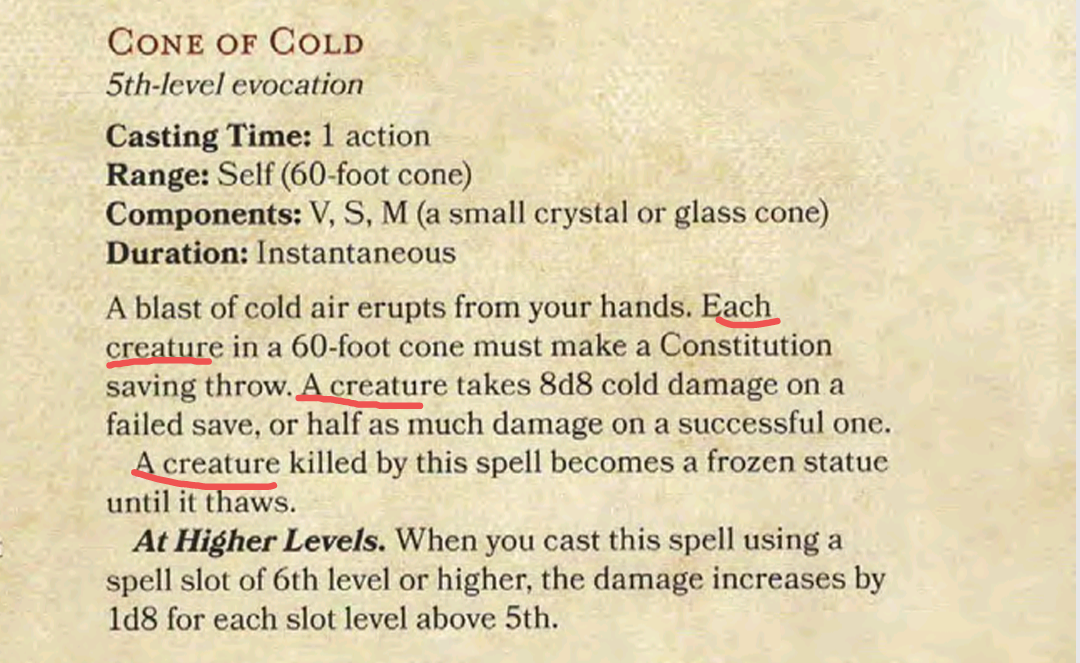
But in the spirit of this thread, if we’re applying a rigidly narrow interpretation of the rules as written, a spell only does what its description says it does. Cone of Cold does not say it damages objects. It says it damages creatures that fail a saving throw.
Yes, Chapter 8 says “Characters can also damage objects with their weapons and spells” - and indeed they can, if they use a suitable spell such as Fire Bolt or Shatter which can damage objects according to its spell description.
Again, that’s Rules Lawyer Jesse Pinkman talking, and does not represent my own beliefs or opinions.
Nope
Nope
It’s Saturday August second along mine. I didn’t realize that two different days across time zones could still share the same day of the week.
Of all the things for the AI to mess up, I wouldn’t have expected inconspicuous typos. “A” instead of “an,” “orld” instead of “world”
What a coincidence this came across my feed, I just started playing Kingdom Come: Deliverance yesterday!
I almost ragequit in the first few hours but it’s pulling me back in
I love that you used the Skeleton artwork from the 1993 Monstrous Manual
…
I’m not sure how to feel about the fact that I immediately recognized it
 2·6 months ago
Ah, thanks. I had to look it up. I think my folks just call them hand towels
I still don’t get it…
The more you eat, the more you toot. 🎺
I agree 100% with your sentiment about the quality and depth of supplemental books having sharply dropped off! I don’t know exactly where the turning point was for me… sometime around Tasha’s Cauldron and its variant rules for racial traits, maybe… but I definitely lost interest in anything new that they put out. I saw how thin Spelljammer and Fizban’s Treasury were, and thought… “that’s it?!”
If you don’t mind indulging me, could you elaborate on what you like better about GURPS? I tried to get into it, but was quickly put off by its extreme granularity. Character creation boiled down to (and I’m paraphrasing),
You can be literally anyone or anything!!! …as long as you meet the budget for points. However, this is a setting-agnostic system, so make sure you check in with your game master to see if your concept is actually allowed in their game. Also the primary attributes, skills, and point values of various traits could all be quite different than the default presented here because, again, they might not make sense for the setting of your game. So maybe your game master should hold your hand through character creation. But anyways, here’s a three-mile-long list of things you can spend your points on, go nuts!
The foreword also said something along the lines of, “here’s the most important rules, you can ignore the rest of this book and still play GURPS just fine” …but that sounds like the same thing you’re complaining about with D&D? That it leaves SO MUCH up to the game master to decide.
In D&D 5e, personally I appreciated having only the basic rules in the PHB. I felt that combat was complex enough without having called shots, flanking, speed factor, and lingering injuries presented as the default. But when we were ready to increase the complexity, we were quite glad to have all of those additional rules written up in the DMG in a modular format.
Likewise, when 95% of the game is focused on combat, social interaction, and exploring dungeon-like environments, I don’t see any need for the basic rules to include a fine-tuned granular system for downtime activities. “You can create 5gp worth of any item per day using the appropriate set of tools, given that you are proficient, and it costs you half that much in raw materials.” Boom, that’s super simple and it gets the job done for the majority of players who are interested in crafting during their downtime in between the actual adventures. For those hardcore outliers who desire a more fleshed-out set of rules for tools, Xanathar’s includes DC’s for a range of tasks to do with each tool, a list of specific components that are included in each kind of tool kit, and at least three examples per tool for how you can apply it in conjunction with a skill OR use the tool in a special way. It’s a lot more detailed than just “consider giving the player advantage and maybe an added benefit IDK.”
I know you’re frustrated that it’s buried in a supplemental text rather than the core rulebook, but I don’t know. Should the PHB also have the specific rules for large-scale army battles? Maritime navigation? How to play dragon chess? There’s only so much you can fit into the basic rulebook…
Edit to add: I hope I’m not coming across as combative. Your criticisms are definitely valid, and I think it’s a case of different players valuing different aspects of the game. I am genuinely interested to hear from someone who’s played GURPS and stuck with it; there has to be an elegance to the system that I haven’t had the opportunity to see, and I’d love to hear your take on it.
I mean, last I checked you have the option to be proficient with various sets of craft tools, but the system doesn’t actually explain what that actually does mechanically.
Chapter 8, “Between Adventures,” “Downtime,” “Crafting.” Page 187 in the 2014 version of the Player’s Handbook. It tells you exactly how long it takes and how much it costs to create items using artisans’ tools. I concede that it’s pretty generic and would benefit from some refinement, but it does explain what you can do, mechanically, with your proficiency in artisans’ tools.
(If the 2024 version of the Player’s Handbook removed this guidance then I’m not sure what to say, except that I don’t personally consider that version to be “5e.”)
Xanathar’s Guide to Everything also has an extensive section in Chapter 2, beginning on page 78, that does a great job fleshing out each type of tool proficiency and providing novel ways to use them. I highly recommend that if you’re interested in crafting.
 23·9 months ago
Literally every adventure where we have to enter a potentially dangerous castle/mansion/tower. We’re going to climb or fly up to a higher level window because obviously if there’s a trap or ambush, it’ll be at the front door.
combat should be an RP experience.
I agree with you.
The Three Pillars of Adventure: Combat, Exploration, Social Interaction.
These are ALL “RP” and they should all be performed in-character and creatively.
 2·1 year ago
Thank you for the important work you do. I appreciate you.
You’re welcome, turkeys!